























Intrinsic Safety (IS) is a low-energy signaling technique that prevents explosions from occurring by ensuring energy transferred to a hazardous area is well below the energy output required to initiate an explosion. The energy levels generated are significantly smaller but usable and more than adequate for many instrumentation systems. Specifically, the two forms of energy that can initiate an explosion are Sparks and hot surfaces. In other words, the electrical and thermal output is the cause of hazardous reactions. And, like any electrical equipment, the Intrinsically Safe cable exists to limit the risk of hazards at the worksite.


How do you make a cable intrinsically safe?
Electrical cables are already sealed and are sometimes regarded as IS when protected from damage, external electrical or magnetic fields (EMI), and isolated from non-IS circuits. Additionally, junctions and switches pose as potential hazardous ignition points in these environments and electrical circuits.
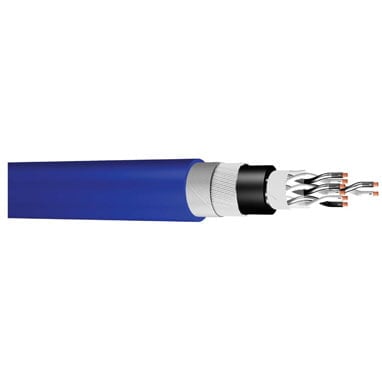
Intrinsically Safe cables contain a blue coating that identifies the potential risk of the electric circuit and the need for special consideration. Furthermore, strong sheathing materials such as polyurethane protect the cables to prevent any mechanical damage that could compromise electrical safety.
Contrarily, Non-IS cables contain a grey coating and carry currents in Non-IS circuits.
Types of Intrinsically Safe Cables
Each Intrinsically Safe cable is a type of control cable. Moreover, each cable is UV and weather-resistant according to ISO 4892-2. Cables are protection type ‘i’ for an IS circuit design; that also come in a range of sizes:
- OLFLEX EB for a flexible, intrinsic safety barrier circuit
- OLFLEX EB CY for high-degree screening of low transfer impedance
- OZ-BL (and other variations) for flexible control & measuring in hazardous areas
Cable Entry and Barrier Considerations
An intrinsically safe cable is only one part of a complete IS circuit. Per IEC 60079-14, the circuit also depends on a certified IS barrier or galvanic isolator at the safe-area boundary, which limits the voltage and current that can reach the hazardous area even under fault conditions. The cable’s own entity parameters (capacitance and inductance) must be verified against the barrier’s and the field device’s entity parameters for the loop to remain compliant — a correctly rated cable installed without matching the full loop’s entity parameters does not make the installation intrinsically safe on its own.
Separation From Non-IS Circuits
Because IS circuits work by strictly limiting available energy, running an intrinsically safe cable in the same conduit, tray, or junction box as non-IS wiring risks inducing enough energy into the IS circuit to compromise its protection. Standards such as IEC 60079-14 specify minimum separation distances or the use of separate, dedicated raceways for IS and non-IS cabling — the blue jacket color is a visual aid for maintaining this separation during installation and future service work, not a certification in itself.
FAQs About Intrinsically Safe Cables
Does the blue cable color mean the cable itself is certified?
The blue jacket is an industry-standard visual identifier (per ISA and IEC recommended practice) to help installers and maintenance staff keep IS circuits physically separated from non-IS wiring. The cable’s actual intrinsic safety depends on its construction and its role within a certified, compliant IS loop — not the color alone.
Can any control cable be used in an IS circuit if I’m careful with routing?
No. The cable’s construction — shielding, capacitance, and inductance per unit length — is part of the entity parameter calculation for the loop. A cable not designed and rated for IS use can introduce enough capacitance or inductance to push the loop’s energy above the safe threshold, regardless of how it’s routed.
Do intrinsically safe cables need re-certification after repairs or splicing?
Field splicing or repair of IS cabling should follow the site’s hazardous area work procedures and use methods that preserve the cable’s original entity parameters; unauthorized splicing methods can alter the loop’s electrical characteristics in ways that are not visually apparent.
Browse our certified intrinsically safe and explosion-proof cables, or ask our experts at 832 699 6726, Monday through Friday, 9am-5pm CST.


What’s up, I check your blog daily. Your story-telling
style iis awesome, keeep up the goo work!
Hello, i read your blog occasionally and
i own a similar one and i was just wondering if you get a lot of spam
comments? If so how do you prevent it, any plugin or anything you
can recommend? I get so much lately it’s driving me mad
so any assistance is very much appreciated.
Greetings, I do believe your site could be having web
browser compatibility issues. Whenever I look at your web site in Safari, it looks fine however, if opening in IE, it has some overlapping issues.
I merely wanted to provide you with a quick heads up!
Apart from that, fantastic site!
Wonderful website you have here but I was wanting to know if you knew of
any forums that cover the same topics discussed in this article?
I’d really like to be a part of online community where I can get advice from other experienced people that share
the same interest. If you have any recommendations, please let me know.
Thanks a lot!
Very quickly this website will be famous among all blogging users, due to it’s fastidious articles
or reviews
I am extremely inspired with your writing talents and also with the format in your weblog. Is this a paid subject or did you customize it yourself? Either way keep up the excellent high quality writing, it is rare to peer a great blog like this one today.
I am really impressed along with your writing abilities and also with the structure on your blog. Is that this a paid topic or did you customize it yourself? Anyway keep up the nice high quality writing, it’s rare to peer a great weblog like this one today.
I am really impressed with your writing talents as neatly as with the structure on your blog. Is this a paid subject or did you modify it your self? Either way keep up the excellent quality writing, it’s uncommon to see a nice weblog like this one today.
I was very happy to uncover this page. I want to to thank you for ones time just for this fantastic read!! I definitely savored every bit of it and i also have you saved to fav to check out new stuff in your web site.
came in good time and looks cute.
All good. Postage could have been quicker – got caught in Customs and pay fee.
beautiful as described. Packed well, and shipped very fast. Excellent Transaction
aaaa+seller fast postage thanks
Best online purchase I’ve made. Pictures were very accurate. We’ll worth the wait and price.
I’m very happy with all aspects of this purchase.
can’t wait to use, it looks great
awesome to buy from, good seller
A good purchase, great deal
can’t wait to use, it looks great
Best online purchase I’ve made. Pictures were very accurate. We’ll worth the wait and price.
Classic, Stylish, Beautiful
All I can say is perfect
Affordable. Practical.
another smooth bargain
All around easy transaction… Thanks
Cheap product! Excellent seller!
I’m extremely inspired together with your writing abilities as smartly as with the format in your blog. Is that this a paid theme or did you modify it yourself? Anyway stay up the nice high quality writing, it is rare to look a nice weblog like this one nowadays.